Showing posts with label The Tories Debunked. Show all posts

14 Jan 2016

Conservatism: A Critique

Hello readers! As promised, here is my essay on Conservatism. Note that while Oli, unfortunately, has been unable to contribute this time—his work at university likely having proven all-encompassing—he may chime in at a later date. Now! Read on.

Firstly, we must clarify what we mean by Conservatism. As is often the case with political ideologies, the term is used to mean many things: it can mean the policies enacted by David Cameron’s government; it can mean the policies in the Tory manifesto (not one and the same thing!); and it can mean the ideals purported by Cameron and co., though these often are very vague and even in contradiction with his policies.

To help answer this question, consider the old adage: it is easier to define a political ideology by what it is not than by what it actually is. This holds true for Conservatism especially. I’ll tell you one thing Conservatism ain’t: conservative. Conservatives, just like Socialists and Liberals, do want change; they just want different types of change.

It is true that Conservatism doesn’t like drastic social changes; partly this is because they view our society as being generally a Good Thing (albeit flawed), and because—in the case of the Conservatism promoted by Cameron & co.—the status quo benefits them. That said, even Socialism and Liberalism aren’t too fond of grand ideological projects. This is because all three ideologies are pragmatic at a fairly fundamental level. Communism, for example, is an ideology many Socialists like in theory if not in practice (although there are exceptions—Socialists consider private property a human right).

Conservatism is distinct from other right ideologies—like Libertarianism or Anarchism—in a much more substantive way, however, than is Socialism distinct from Communism. Whereas Socialists generally find the Communist ideology palatable (if implausible) Conservatives are typically horrified by Libertarians. This is because Conservatives view the world in a way fundamentally different from other rightwing ideologies. Conservatives are moderate in their nature, yes, but there’s more to it than that.

Conservatives are actually proponents of government, in ways Libertarians and Anarchists certainly are not. They view the State as being crucial for a civil and successful society—life without government would, in the words of Hobbes, be ‘solitary, poor, nasty, brutish and short’. Where Conservatives differ from Socialists is in the functions and role of the State.

Certainly, Conservatives do want the State to uphold law and order (in fact they’re usually very keen on this—likely because law and order keeps their property safe from the proletariat), and to fight wars, and—in the case of pre-Thatcherite Conservatism at least—to build housing and nationalise industries if it is in the overall interests of the country.

Now: Cameron’s Conservatives have no such interests these days. This is because their Conservatism is a bastardised Conservatism—while this ideology has always been supported by the wealthy, the comfortable and the would-be bourgeoisie, it never went as far as to continue with obviously pernicious policies (like inflating house prices) because it benefits a tiny few. The modern Tory party is essentially a cult of the rich.

But what, you may ask, do Conservatives believe that is different from Socialism—if Cameron’s party is indeed bastardised?

In truth, Conservatism and Socialism are not really all that different. Even things traditionally attributed to Conservatism—i.e. bigotry: opposition to gay marriage, racist language (‘if you want a nigger for a neighbour, vote Labour’) etc.—are unnecessary additions to Conservatism, and indeed not even exclusive to the right. (Many cabinet ministers in Atlee’s government were none too happy about Caribbean immigrants, for example).

But there are perhaps three things that distinguish the two ideologies more than anything, in practice. Firstly, Conservatives have an enduring belief in the virtues of Capitalism; and, especially these days, lightly-regulated market capitalism and financialism. Socialists understand the benefits of Capitalism, and employ it to some degree; but they’re much more skeptical, particularly when it comes to banking, climate change, and the goodwill of the bourgeois class.

Secondly, Conservatives place less of an emphasis on equality (of outcomes especially). While they actually tend to like equality, and especially equality of opportunity—the example of the poor man who worked hard, went to university, and became wealthy is one they’re especially fond of—they are not concerned with the struggles of the working classes like Socialists are.

And finally, Conservatives have very different ideas about the causes of wealth and poverty than do Socialists. For a Socialist, wealth and poverty have a number of causes; most pertinently they are: an economic system that, by its nature, empowers the already powerful and weakens the already weak; and social power, allowing the wealthy a bigger slice of the pie. But most of all, Socialists view poverty as the product of disenfranchisement, insecurity, and a lack of education; this then leads to comorbid problems like obesity and alcoholism.

For a Conservative, wealth and poverty have more to do with virtuousness. They sometimes view the poor as uneducated, bad with money, or (perhaps) a little bit unfortunate—but often they view them as feckless scroungers. The wealthy they view as paragons of society.

For the three reasons that Conservatism differs most greatly from Socialism, so too does Conservatism fail intellectually. Here’s why.

Capitalism and the Proclaimed Virtues Thereof

The first key flaw with Conservatism, I think, is its faith in Capitalism. This is not to say that we should all be Marxists—for pure-command economies are almost as bad as pure market economies. But I do believe Conservatives have a faith in the market and in business that is rarely warranted.

Allow me to employ some examples. The Tories in the early 90s thought it a good idea to privatise rail. After all: the market will be more efficient than the big, bureaucratic British state—right?

Wrong. To quote from my polemic on Jeremy Corbyn:

The case is overwhelming: since privatisation, railway ticket prices have increased 22% (adjusted for inflation); subsidies have increased, but most of the money has gone directly into shareholder’s pockets; and the UK has rail prices that are as much as double those of nationalised European nations. (We Own It)

Furthermore, it is estimated that simply by not having to pay shareholders, the government could chop off 18% from ticket prices. (ibid.)

Nor can it be argued that the railway companies provide better service: the average age of the trains has gone up; and to add insult to injury—they are more overcrowded, too, with only a 3% increase in carriage capacity to meet a 60% rise in demand. (ibid.)

So how did the Big Bureaucratic British state (and all those Eurocracies like France and Germany over the Channel) manage to run trains better than corporations?

The answers are not simple, but nor are they that complicated. The companies that took over from the state were oligopolistic and continue to be oligopolistic; they rarely compete directly, and employ predatory pricing to keep out competition (the latter has been reduced due to regulation). The Conservative vision of free choice and successful competition did not materialise. Railways do not have many alternative routes and they cannot easily be replaced by other modes of transport.

Then there’s economies of scale. One big state can do things more efficiently than a lot of little companies—it benefits from technical advantages, in managing railways and trains en masse; it can buy things en-masse; and the state benefits from very low interest rates.

But more than anything, the case of nationalisation—in rail, and even more obviously in the NHS—proves the Conservative spiel wrong. Markets do not tend to equilibrium; often they are not efficient, and not run in the interests of the many. This is because markets, rather than being like gyroscopes, are more like a complex interacting web of varying, often contradictory human interests. Furthermore, consumers are often irrational (buying goods on the basis of marketing and social pressure) and lack the information and available time to make rational decisions if they even wanted to.

Consider a supermarket. Suppose you want to buy detergent. You, in the belief of the free market economists, must—from the dozens of brands and products available on the shelf—know which detergent does the best job, consider the externalities of detergents (like their effect on aquatic life), and then select the exact product which maximises your utility.

Want a phone? Better not be swayed by those shiny iPhones that all the cool people seem to have. Want food? Best know exactly how each product on the shelf tastes. Want fashion? Best know how the workers in Bangladesh are treated. And so on.

And so not only are Conservative beliefs in the market suspect, but so too are their arguments against the state. As Germany shows us—heck, as our own NHS shows us—states can run companies than not only act in the interests of broader society, but that are also managed efficiently. Why? Because it is in everyone’s interest to have well-run public services.

Of course public services are not always well-run. Bad relationships with unions, racial and class-based antagonisms, and incompetent politicians (both lower down and higher up) can derail good public services. But there is one key difference between this and a badly-run corporation: we can do something about it. It’s under our control. The corporation, on the other hand, is run by the CEO, Board, and Shareholders. Our ability to influence it is far reduced.

However, an even more unwarranted Conservative belief is in the virtues of Financialism. To quote from the Tory’s ‘Freeing Britain to Compete’ report (published 2007!):

The (Labour) government claims that this regulation is all necessary. They seem to believe that without it banks could steal our money ……………

We need to make it more difficult for ministers to regulate, and we need to give the critics of regulation more opportunity to make their case against specific new proposals………

We recommend deregulating venture capital fund raising, and investment for professional investors………

A Conservative government should relax banking regulation, allowing a new breed of venture/micro-credit institutions…………….

(Quotes courtesy of Pride’s Purge)

As we all know, the big crash of 2007 proved all the above to be pure fantasy.

I won’t go too much into the why. Suffice to say that the usual happened: the market system had its way; banks gambled, making short-term profits that could only lead to a bust; consumers didn’t know any better; and the financial interests of the bankers led not only them, but the entire political establishment, to abandon reason.

Anyway: I think I’ve covered this flaw insofar as is feasible short of writing an economics book on the topic. Let’s address our next bug-bear—equality.

Conservatives and Equality

Unlike some, Conservatives by and large like equality. In fact, they make quite a fuss about the equality of opportunity. They even, in fact, like to have equality of outcomes (though not, of course, if it openly contradicts the diktats of the market—or the interests of their donors).

Conservatives also like to attack Socialists because Socialists ‘would limit the great so as to be equal to the mediocre’. This, however, is a misunderstanding of Socialism; the real mistakes are being made by Conservatives.

Firstly, Socialism does not want to shackle the good to remain with the bad; rather, they wish to free the good (and the mediocre) from the oppression of the lucky undeserving.

There are two examples that best illustrate my point: housing, and education.

With education, Socialists are quite keen on equality of outcomes. Why? Because equality of outcomes, in reality, is crucial to equality of opportunity. A good student—even if possessed of wit and determination—will struggle in an environment characterised by chronic insecurity in housing (i.e. constantly having to move); in one where their parents are alcoholics, and/or abusive; and in which the tools of their success (books, computers, free time) are unavailable due to poverty. It’s hard to read Adam Smith’s the Wealth of Nations—and become a brilliant economist—when you’re parents need you to work at Asda’s to pay the bills. And ditto becoming a photographer if your parents can’t afford cameras.

It is because equality of opportunity needs at least some equality of outcomes (even substantial equality of outcomes) that the Conservative ideology becomes self-contradicting.

Indeed, the current Conservative government is acting very much against either equality. In housing, they provide ‘Help to Buy’ (i.e. demand subsidies) to further inflate house prices and drive more people into the loving arms of Buy-to-let landlords. And God-forbid you suggest building houses, be it council housing or housing for private ownership; only the market can do such a thing!

As for education, I have some trouble understanding how removing maintenance grants (to help poor students pay for accommodation while at university) and introducing £9000 a year tuition fees can possibly aid equality.

(The latter issue is a bit more complex, of course, but the principle is simple: students who have to go into £27,000 of debt will struggle to pay back that loan when they’re confronted with unemployment or low wages for entry-level graduate jobs. The difference between the haves and have-nots will be exacerbated, however, since the haves can rely on the bank of mum and dad. Not so the have-nots.)

Wealth and Poverty

The final misconception underlying Conservatism is, with little doubt, the supposed causes of wealth and poverty.

Conservatives frequently portray themselves as being pragmatic and in touch with reality. But their notions of poverty are anything but in touch with reality—let’s see why.

Firstly, we must ascertain why poor people are poor. The topic is of course very complex, but here are the key causes I’ve both personally observed and which the data supports:

  1. The conditions of the labour market. It’s really quite simple: with the way things are set up, we need people to work in supermarkets; to waiter in restaurants; and to staff call centres, act as cleaners, and work manual jobs. These people will not be paid very well. Salaries ranging from the minimum wage (like averaging around £14K/year gross or so) to, at most, £20K will be the norm.
  2. So you see, whichever way you cut it, some people are going to be rather poor—unless you can improve their pay. This would, among other things, involve playing nice with the unions.

  3. Unemployment and working conditions. Even with Osborne’s miraculously low figures approaching 5%, people are still unemployed; JSA is not very much money; and quite a few people are living insecurely under zero-hour contracts and forced self-employment.

  4. Chronic mal-education, depression, and social problems. In my experience, those from poor families lack motivation in school, and are doomed to repeat the mistakes of their parents.

  5. Some people are poor because they’ve been rendered unfit to work (due to disease or disability) and receive little support from the state.

Conservatives seem blithely ignorant of pretty much all of the above. For the first point, they seem to believe all it takes is ‘education’. Sorry to break it to you folks—but unless you stop going to restaurants, clean up after yourselves, and have robots cash the till, these people will need to be hired. Giving them degrees or A-levels won’t make a damn bit of difference. In fact, quite a few graduates do end up working manual jobs—and never repaying their university debt.

As for point two, some easier solutions are available. We could abolish zero-hours contracts for larger firms. We could force employers to contribute to National Insurance, and have NI really be an insurance—paying out a guaranteed sum of money, every month, regardless of working hours for as long as the individual is employed by the firm.

Unemployment and self-employment are trickier. The NI scheme could perhaps the extended, again, to cover self-employed people. But unemployment is a problem fundamental to capitalism. To even go into it would be the topic of high-level economics; but suffice to say that a combination of the National Education Service (already proposed by figures in my party), more state control of the economy (yes), and possibly even printing money may be effective.

As for points three and four, you will see little sympathy from Conservatives these days. But one thing is for sure: ignoring them doesn’t mean they’ll go away.

Wealth and Tax

The final misconception I wish to address, going on from the above, is wealth and taxation. Conservatives don’t like raising income taxes, especially (it would seem) on the rich. Partly this is because of obvious reasons—the Tory party is funded by the rich. But a number of ideological and practical reasons are given.

  1. It (a 50% tax) won’t raise revenue. False—the 50% tax didn’t raise revenue because it was only introduced temporarily and because rich people forwarded their asset gains. This basically means that they reported lower-than-usual incomes when the tax was introduced, and higher-than-usual incomes after it returned to 45%. So effectively the 50% tax collected abnormally low revenue, and the 45% collected abnormally high revenue. One must also consider taxes in the context of Osborne’s significant cuts to HMRC staffing; if Osborne doesn’t staff HMRC properly, then of course they won’t be able to catch tax evaders (of which there will naturally be more of if the rate goes up to 50%).

  2. Tax is bad—it causes growth to stall because people have no incentive to work. False; as I’ve written already this argument fails to consider how revenue collected by the state can be used to increase economic growth—by training the engineers of tomorrow, keeping our roads and railways running quickly and efficiently, and by providing health services at a much lower cost than comparable private health insurance. Even benefits can lead to economic growth. Housing benefit—recently chopped by Osborne—puts a roof over the heads of some very young and very vulnerable people. By doing so, these people are much more likely to become successful, tax-paying members of our society as opposed to criminals costing police time, or sick people in NHS beds.

  3. The rich don’t deserve to be taxed—they worked hard for their money.

The final argument is symptomatic of the last Conservative mistake. Rich people do work hard for their money (unless they inherited, of course!) but normal people work hard too. They don’t become rich. This is because rich people are in a very economically privileged position: firstly they had the upbringing and resources to allow them to e.g. become software engineers; secondly, they had the trust of the wealthy to obtain capital (since rich people are overwhelmingly of the capitalist class); and thirdly, they were lucky. They hit the market with the right product at the right time. They’re not more virtuous than mere mortals!

What’s more, rich people should pay taxes—because, firstly, they can (unlike poor people) and, secondly: because they more than anyone benefit.

That’s right—even if rich people don’t claim benefits, they are the chief benefactors of state investment nominally. What allows Jaguar to be successful? Engineers and designers who went to schools funded by the state. What allows people to buy cars? Roads funded by the state. Who enforces contracts for Jaguar? The police, funded by the state.

And so why should Jaguar’s CEO, who earns £4.5M, not pay taxes? (One could even ask why he’s given such a handsome share of the pie, but that’s a topic for a different essay).

But this example challenges Conservatism in yet another fundamental way. Conservatives think of wealth as private—‘it’s my damn money,’ in Thatcher-speak. But in reality, wealth is just as much social in character as individual; because nobody makes wealth on their own. Jaguar’s CEO’s wealth stems from Jaguar cars; that’s the ‘wealth’ in this equation (which must not be conflated with money). The CEO doesn’t make the cars himself. The people who work the factories, who design the engines, who style the cars; they make the cars. Who gets the wealth is a social decision—because the wealth is created collectively!

(Note that this is not to say the CEO does nothing at all; that would be a gross failure to understand the demands placed on a modern car company, and the role of the CEO.)

Conclusion

This essay has proven lengthy. Despite this, I have not been entirely concise; for such is the nature of the blog. Doubtless, explaining some of the underlying economics and philosophy would take up a book’s worth of words.

But I do, however, hope that this essay has at least challenged you—if not convinced you outright. Beware the claims made by Conservatives. The truth is often complicated…

12 Jan 2016

2016 in the Magical Realm

Hail readers!

With the advent of the new year, I have decided to update you both on my personal situation, and on the plans determined for the Magical Realm in 2016.

Firstly, I am back in England once more. My foray to the Schwarzwald over (it having been otherwise pleasant if not for my unfortunate car accident) I am now back in school—and back to work. Although my A-levels do of course take up my time and efforts, I have nevertheless plans for 2016.

But before I go into that, why not take a look at my photos? I have taken photograhs of my skiing adventures; of an impressive cathedral I was fortunate enough to visit; and of the landscape of the Black Forest.

Now! Without further ado, here is a list of my goals for 2016 here on the Magical Realm:

  1. I am preparing an essay with Oli (on problems with Conservatism) and this I shall publish soon. It shan’t be my only political essay, of course, for the year; and hopefully Oli can join in others.
  2. I shall write more on current affairs.
  3. I shall continue writing the Ark. In fact: I may even decide to feature more chapters, particular scenes, and even feedback from early readers.
  4. The Magical Realm will, at some point, be getting an artistic make-over. The current ice-blue colour scheme (appropriate for the phantasmagoria of the Necromancer) shall be replaced by something more true to the Ark. Perhaps a Sci-Fi landscape will feature, or even—more boldy—something related to the protagonists’ romance. The Ark is a very blue novel in terms of landscape and phantasmagoria, however, and so it is possible the current ice-blue theme will be replaced only by an alternate sky-blue.
  5. Finally, I am considering extending the technical aspects of the Magical Realm to include a more dynamic interactive model as opposed to the current static one. Early plans include a home-page with a slideshow depicting various major posts (and comments) along with ‘news’ banner—to include e.g. where I am—as well as: a section of the blog where all book-related posts and published material are kept; a more interactive way to read and purchase my books; and even integration with social media.

Well, that’s it for now folks. Keep with me for my upcoming essay on Conservatism. And Happy New Year!

27 Oct 2015

Jeremy Corbyn: Not so Unelectable

Owing to substantial interest from my readers, I am bumping up this post—and including additional data. If you wish to comment, please do so below; and apologies for my lackadaisical blogging efforts as of late. The Ark is growing steadily...

A strange malady seems to have overtaken the Labour party. Some call it ‘Corbynmania’; others call it, more simply, ‘madness’.

But most call it ‘hope’. And it is indeed the majority who decided the fate of the Labour Party that Saturday—let us not forget that. So: what are we to do?

Certain wings of the party—notable proponents include Simon Danczuk, Chuka Umunna and Liz Kendall—are reluctant to move forward. ‘This is madness; we will be annihilated; what disaster has befallen us!’ they claim.

Absurd as it may seem, their claims require careful consideration in order to be proven, or—as I will show—disproven. And we cannot ignore them; if not for preserving ‘party unity’ then for a more simple reason: they may have a point. If Jeremy cannot keep the party together, if his policies are not workable, or if—most importantly of all—he cannot convince the wider electorate to vote for them, then the Labour party must be prepared.

A relative minority of Corbyn supporters have expressed support for the idea that, even if Corbyn doesn’t do very well, he would at least have stood fast to principle. To this I say: rubbish. Power without principle is anarchy; but principle without power is a pipe dream. If some form of compromise is indeed necessary, we owe it to the people we represent—not just the disabled and the poor, but also the millions of middle-income people fooled by the Tories—to win power.

But are such grave compromises really necessary, and is Corbyn the unelectable disaster some profess him to be? Let’s take a closer look.

Renationalisation etc.

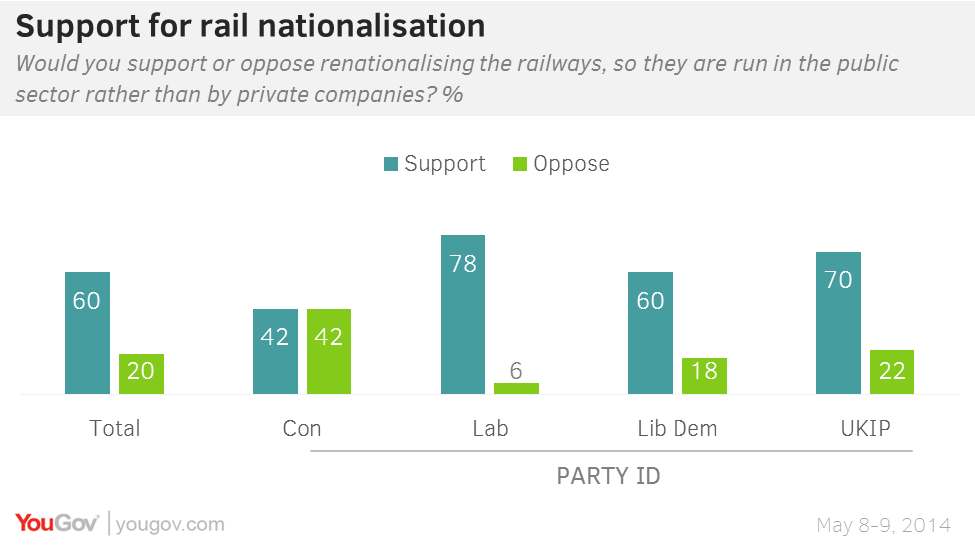
One of the matters that Corbyn is rather popular on—despite claims made by ill-informed media commentators—is in his idea to renationalise the railways, the Royal Mail, and to a lesser degree the energy companies. I previously quoted polls conducted by YouGov in my analysis of Socialism, but it is worth re-iterating them:

Renationalisation poll

Interestingly, we see that not only are Corbyn’s policies popular among his own party and other vaguely left-leaning parties like the Lib Dems (as well as the SNP, etc.); but that they are popular in general, and significantly by UKIP voters and even quite a few Tory voters.

So: Corbyn’s not going to have any trouble pushing that through.

A similar story may be found with regards to renationalising Mail and Energy:

Renationalisation poll no.2

So, on the basis of public opinion, Corbyn is not going to have any difficulty finding supporters for his renationalisation policies. However, there is another question to be had here: is it actually a good idea to renationalise, and if so, how can this be achieved?

Let’s start with rail. The case is overwhelming: since privatisation, railway ticket prices have increased 22% (adjusted for inflation); subsidies have increased, but most of the money has gone directly into shareholder’s pockets; and the UK has rail prices that are as much as double those of nationalised European nations. (We Own It)

Furthermore, it is estimated that simply by not having to pay shareholders, the government could chop off 18% from ticket prices. (ibid.)

Nor can it be argued that the railway companies provide better service: the average age of the trains has gone up; and to add insult to injury—they are more overcrowded, too, with only a 3% increase in carriage capacity to meet a 60% rise in demand. (ibid.)

Renationalising them isn’t complicated either. The UK state still owns much of the rail infrastructure, and the companies run the trains on franchises; when they expire, the state can run them once more.

The energy companies—known collectively as the Big Six, and owning over 95% of the marketshare—have also increased their prices by between 40% and 20% (for gas and electricity respectively) since 2007, despite seeing a tenth-fold rise in profits within the same period. (We Own It) The latter is particularly damning: while the global price of gas varied significantly at that time, the substantial rise is down mainly to companies pocketing a healthy profit.

Natural Gas Prices 2007 est

Indeed, Corporate Watch even calculated that nationalising the energy companies would serve to bring savings of £150 a year to each household, on average. (CorporateWatch)

But how are we to nationalise them? This is where Corbyn gets into some difficulty. Buying the companies at market rate is out of the question: it would cost £185B (TheGuardian) He could theoretically impose price freezes, regulation on passing down the cost of falling gas prices, and so on; this would lower their stock value, allowing these companies to be bought cheaply.

That, however, is no way to run good government. More likely, Corbyn can attempt a municipal system of state ownership: municipalities can run their own power stations, and charge their customers accordingly. Alternately, the state could simply buy one company, and let the others go out of business. That’s capitalism for you.

Welfare, And Other Tricky Matters

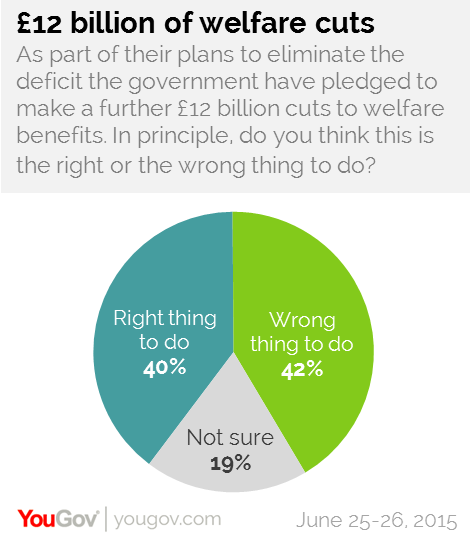
This is perhaps where Corbyn may fall. The public’s opinion on welfare seems rather divided:

Welfare Bill Poll

However, the situation is not so simple as it looks. For one, a lot of opposition to welfare in general stems from certain assumptions—apocryphal ones:

The amount of misinformation presented to the public, and supported by the Tories—implicitly or explicitly—is remarkable. One woman believed the Tories to be the party of the poor, and Labour... not so. She also apparently believed that the rich shouldn’t pay more tax—evidently the trade-off was not clear: if you support this, you will pay more tax yourself, or you will face cuts to the NHS. (In fact, the Tories have done just that—by scrapping tax credits.)

A pair of women believed that the Labour party supported the ‘scroungers’—people who don’t want to work, and want to stay on benefits.

Liz Kendall was right to point out that the Labour party has a serious problem: the public believes Labour to be the ‘something for nothing’ party. But Kendall’s response wasn’t the correct one. The solution is not to feed into this nonsense; not to agree that the ‘scroungers’ are stealing the taxpayer’s money (fact check: fradulent benefit claims make up 0.7% of the welfare budget (ONS)) or that Britain is facing some imminent crisis on welfare.

Because Britain is facing a welfare crisis, and that’s the one created by Iain Duncan Smith: his regime is responsible for the deaths of thousands. (TheGuardian)

Still, there are turbulent times ahead. Getting Labour’s message out to the public, and killing these apocryphal rumours where they stand—well, it won’t be easy. Perhaps it would be easier to compromise. But it wouldn’t be the right thing to do; at least not if compromise requires near total capitulation, as seems to have befallen Kendall.

Trident, NATO, and Other Matters

I shan’t be discussing these matters overly much. I have already stated that I disagree with Corbyn’s foreign policy, on my Socialism essay; but I’m not so presumptuous as to think the public are wise enough to agree with me. The media commentariat evidently needs to get out more—the polls tell a story very different from their narrative...

Poll: Syria Bombing

The public are opposed to extending the bombing campaign on Syria... Source: The Independent

Jonathan Knott, over at OpenDemocracy, is also worth quoting with regards to how much voters actually care about NATO and Trident...

So 55% supported retaining nuclear weapons in some form. But given that before they were asked specifically about Trident, about a quarter (23%) didn’t know whether the UK had any nuclear weapons or plans to replace them, it’s hard to argue that this is a high priority for voters.

Nuclear weapons too expensive poll

This ComRes poll also has an interesting tale to tell... Apparently, voters mostly agreed with the statement: ‘Nuclear weapons are too expensive for governments to maintain.’

Minimum wage support...

The public also seems quite amenable on other aspects of Corbyn’s policy, including support for the minimum wage and rent controls...

Immigration

Readers have enquired as to why I omitted a section on immigration; the answer to this is: it simply did not cross my mind at the time. I am, generally speaking, not particularly concerned about immigration—nevertheless, as with many issues, I do not presume to be in the majority. The public’s views on immigration are somewhat complex; it’s worth taking a look at a lot of the data.

Firstly, the picture very generally appears to be that the public feels negatively about immigration—in economic terms particularly:

(It seems almost superfluous to mention that nearly all economists—like those from the Imperial College, or the National Institute for Economic Research—have come to the conclusion that immigration is positive for the UK economy; opinion triumphs knowledge, it seems.)

Nevertheless, the picture is more complex than this. For one, more people believe that refugees should be allowed in as opposed to not (48% versus 38%); further, more people believe that NHS staff from abroad should be allowed in as opposed to not. (YouGov).

As usual, I feel it necessary to bring some facts to bear. A lot of people are under the impression that immigration has dramatically increased in recent years, for example:

With Farage’s and Cameron’s rhetoric, it’s not hard to see why. But as is sadly all too often the case, this is not what is actually happening—at least not so simply.

Source: Migration Watch

While net migration has been unusually high this year and the year before, it was significantly lower between 2011 and 2013; lower even than the years previous. Why? Finding the exact causes would require more words than I’ve time for—but, likely, we are seeing both statistical variation (notice the variation in the early 2000s and in the 80s?) and the effect of one of the largest refugee crises in recent history. The NHS also saw significant shortages of qualified medical personnel, which perhaps explains another part of the equation.

So: how would Corbyn fare in this matter? It’s hard to say. Corbyn is pro-immigration, yes; but if he would be able to convince others of his point of view (as good politicians are meant to) then this may not prove a problem. Further, it is hard to determine exactly how this would sway an election result—a lot of people are concerned about immigration, but are they not also concerned about unemployment, financial security, and housing? And what exactly are the other parties going to be offering in that dimension?

UKIP only won one seat—so voting for them is unlikely to result in any meaningful change—and their policy on the economy ranges from the merely very stupid (like flat tax: if you earn £16K and have lost your tax credits, prepare to pay more tax—just like the banker on £150K!) to the absolutely moronic (like scrapping the NHS—or has Farage changed his mind yet again?) The Tories are trying to make millions of people £££ worse off, and their housing policy is responsible both for the enormous increase in house prices (by subsidising demand, and and not regulating banks) and for the shortage (by not allowing councils to build houses, among other things). The Liberal Democrats promised to do a lot of things in 2010, like getting rid of tuition fees. Instead they tripled them. If you can’t trust them to fulfil their most important promise, why trust them with anything else?

But I digress. On immigration, Corbyn is, for once, in the minority. Nevertheless, there are a number of other issues to contend with—not to mention the vagaries of the FPTP system.

To Conclude

This post has been rather detailed and indeed rather lengthy. But a clear picture emerges here: Corbyn is not unelectable—his policies are popular, especially on the economy (the living wage, rent controls, and renationalisation) while even his more contentious foreign policy is far from the fringe position the commentariat makes it out to be. Indeed, Corbyn is more often that not with the majority.

Is this to say the sailing will be smooth? No. As I said before, Corbyn isn’t a man full of charisma; his ‘authenticity’ may go down well, but he is less than prime-ministerly. Don’t think this matters? Look at Miliband. Many of his policies were popular too, but he failed to win; if he had possessed better personal ratings, we (probably) wouldn’t have a Tory government.

Nor will things be easy on welfare: there is a widespread misconception of what the situation is really like, and on what the Labour party stands for. And let’s not forget the parliamentary Labour party, too; there’s quite a bit of opposition there, sometimes with reason (in the case of printing money, or leaving NATO, or on Eurotoxicity) but not always—as Danczuk and his ilk show.

Still, there’s reason to hope. The country is far from the right-leaning, NATO loving, Tory-lite image that the likes of Rafael Behr and Jonathan Freedland would have you believe. The Tories are a minority, after all; and many Tory voters aren’t Osbornomicists—but people deceived by misinformation on welfare, on immigration, and on what the Tory party really is. (Hint: they lowered inheritance tax for millionaires and cut tax credits for working people. They sold off the Royal Mail at knock-off prices to their chums in the City. Who the hell do you think they are?)

So to all this, I say: Labour, get ready to fight. Blairites, shut up—or Labour won’t get elected, and it’ll be your fault. Corbyn? Get a tie.

15 Oct 2015

On Democracy

As of late, my efforts in the blogosphere have been somewhat lackadaisical. I do apologise, dear readers; but the work of a writer is varied, and my upcoming novel—the Ark—is no small endeavour. Not only am I continuing with writing it (Chapter Six, as of present time) but I am also receiving feedback from a secret beta-reader.

Furthermore, I have also applied for the annual Jefferson Prize, hosted by the Missouri Review. This has involved a careful consideration of my current poetry, and certain improvements: the Necromancer, for example, has received changes in language and expression to certain strange or overly archaic sentences; other poems, such as Essence and Objet D’Art, have also been edited.

But no matter. Today I shall be writing a relatively brief (but hopefully informative) essay on democracy.

The matter is naturally very complex, and the following assumes basic familiarity both with current political events (such as Osbourne’s ‘Charter of Cuts’) and the principles of political philosophy as elucidated on by the likes of John Stuart Mill, Hobbes, etc. There will also be some matters of economics being debated; but I shall explain those with (I hope) sufficient clarity to avoid prior knowledge requirements.

Anyway: down to business.

Against Democracy—Part One: Tyranny

In any debate concerning systems of government, one must firstly consider what one wishes to achieve and the priorities thereof. Let’s take some basics—good government should be the following:

  1. Just. It must act in a manner that is fair to all members of society: tyranny is something best avoided.
  2. Effective. Not only is effective government desirable generally (no one likes a government perpetually frozen in gridlock, like the American one, or tending to compromise to the point that it pleases neither side) but it is also imperative in meeting the condition above. Bad government results in corruption, incompetence and economic meltdown. A government that wastes its citizens’ money, or reneges on its citizens’ trust, is fundamentally unjust.
  3. Pleasing. It is desirable for government to please all those who differ in opinion; for dictatorships and (to lesser extent) monarchies are often found lacking in engagement with the all opinions present. It is also to some degree necessary for condition 1, since a government run by the few tends to be… for the few, and is once more unjust.

For condition 1, democracy initially seems a good idea. After all: tyrannies usually develop in non-democratic nations—like Syria or Saudi Arabia—due to, in theory, the fact that government is run by a small and very specific minority (typically old, wealthy, religious and powerful men) and not by the people. Hence, the answer is democracy: demos (the people) and kratia (power). Right?

Well, no. Firstly, it is quite plausible for the majority to act tyrannically towards the minority. Uganda is a democratic country, but it behaves tyrannically towards its gay citizens; the US, also a democracy, behaved tyrannically towards black people. Democracy is no guarantee of justice—and the sooner we dispel this myth, the better.

But democracy doesn’t just suffer from the problem coined ‘The Tyranny of the Majority’; it also suffers from the tyranny of the minority. Yes, you heard that right. Governments are highly able to deceive their citizens using outright lies or, more commonly, sophisticated misinformation and obfuscation.

The Commons recently voted against the Assisted Dying Bill by a 2/3 majority. But 80% of the populace supported the Bill, according to the polls (which have predicted general election results quite reliably, for example). Why is there such a disparity? Well, it seems that the House is composed disproportionately of a minority, that is both more religious and has very little experience of what it means to be in hardship.

But suppose the UK was a direct democracy, and not a Republic. What then?

There are several practical problems with direct democracy: the majority of people are busy with work and family, and don’t have time to consider and debate complex issues of government.

But even if the UK was more like Switzerland, there will be other instances when the majority still manage to vote against their own interests. One such example is to do with taxation. Watch the following:

Notice, after around 2:30, the lady who believed the rich should not pay more tax; and yet was on £16K herself? The people earning enough to pay the top rate of tax in this country are on £150K: this is nearly 6 times the median wage, and only 1% of the populace earn it. If the lady were actually making decisions based on her self-interest, she would want the rich to pay more taxes. If they pay more, she pays less. Likewise would the other 99% of people earning less than £150K.

So why doesn’t this occur? The cause lies with ignorance and misinformation. Firstly, the lady may well have been ignorant enough to simply not know this simple fact. But the Tory government and its proponents are also very good at misinformation generally: they claim ‘trickle-down economics’ as a basis for their policies. The trouble is, if the rich get richer everyone else stays where they are. ‘A rising tide lifts all boats,’ may be good rhetoric, but it isn’t good economics.

The theory has already been debunked even by such conservative bastions as the IMF; but let’s briefly examine the claim a priori. How can the rich getting richer make life better for the poor? Why, by buying things from them! If there are more rich people going to the restaurant, the waiters get more tips. Right?

Wrong. The theory fundamentally misunderstands the workings of a trade economy. When the rich buy something from a poor person, they exchange money (a proxy for wealth) with a resource, e.g. being served food. But so too does the poor person exchange money with the rich when they, for example, buy a computer with Microsoft Windows. Is this to say that the poor make the rich richer, and the rich make the poor less poor?

That’s one way to think about it. More correctly, a trade economy is one in which one good is exchanged for another; the goods are equal in value (theoretically, at least) and so all that happens is that one agent exchanges a good they consider less useful with another agent in the same situation. To take an example: consider a baker. He has baked 100 pieces of bread that day; but since he cannot eat 100 pieces of bread, he exchanges 95 of them for a new coat. The taylor, for his part, gets bread for the coat he doesn’t need.

The point is: neither is materially worse off, or better off, following the transaction. All that occurs is that one good, of equal value, is exchanged for another that the persons involved find more useful to them personally.

The Tories use many more such myths to lie to the population. Jeremy Hunt would have you believe that taxing the rich makes them work less; but the empirical evidence doesn’t support him. Not only is there no connection between marginal rates of taxation and earnings in the data, but even countries like Denmark are still highly wealthy despite (it would seem) having marginal rates of taxation in excess of 50%. Indeed, the UK had higher rates under Thatcher, and higher rates still under Churchill. This and other claims I address in further detail here.

Which leads me onto…

Against Democracy—Part Two: Ignorance

The above has shown us that democracy often is tyrannical, either because it is majoritarian or because its citizens are ignorant.

But ignorance is problematic not only for the cause of justice, but also for the cause of effective governance. One prime example is Osbourne’s ‘Fiscal Charter’—or as Labour call it, the Charter of Cuts.

Osbourne’s piece of legislation effectively requires governments to run surpluses under ‘normal times’. The rationale? ‘Saving for a rainy day,’ or, perhaps more fittingly, ‘fixing the roof while the sun is shining.’

All of which is very relatable for the general public. But the general public doesn’t have a degree in macroeconomics; and this is poor economics.

Why? Because it belies an irrational aversion to debt. Debt is not all bad; a business, like for example Apple, borrows money to hire software engineers, to buy processors for their first machines, to build factories, and so on. Should they give all of that up because they have to go into debt to do it? Of course not! We’d never have economic growth otherwise.

And why is it a good idea for Apple to borrow? Because the profits they make from selling their machines far outweighs the cost of their loan.

The situation is precisely analogous in the case of the government. Should the government not borrow to build roads, and allow our manufacturing to grow, our transport to be faster, and the goods from Tescos to be shipped more cheaply? Should the government not borrow to build schools, and teach the engineers and writers and accountants of tomorrow?

But Osbourne’s charter effectively outlaws this. And that, frankly, is stupid.

Furthermore, there is also a great deal to criticise about Osbourne’s little piece of Keynesianism. The idea that governments can save money to pay their way out of future recessions is tempting for the household economists—but national economies are not households. If a government runs a surplus, it is effectively taking resources out of the economy. It is taking schools away, it is taking roads away, and it is taxing everyone to breaking point. Government savings won’t bring us out of recession; it will take us there.

The real way to prepare for recession lies neither with Osbornomics nor with Gordon Brown’s fictitious ‘light-touch’ regulation. The solution lies with preventing the causes of recessions: insane and stupid risks taken by banks.

But I digress. The problem with democracy is that voters simply have no idea of the complexity behind issues of governance. They vote in ill-qualified and dangerous politicians that run bad governments. And the irony? The voters can’t even see it. Until it’s too late.

For Democracy

I make no secret that I have a somewhat dim view of democracy. But there are important reasons to consider for why democracy may be the least inadequate of the many inadequate forms of government (to quote Winston Churchill).

For one, it is true that other forms of government are not without problems. Hereditary monarchies tend to give ill-qualified and unsuitable individuals high office; while hereditary dynasties can lead to oligopolistic and dangerous groups of people controlling the fate of the nation.

Dictatorships have a nasty tendency to lead to tyranny—few men can hold absolute power without temptation. Furthermore, dictators are still human; and individuals are more likely to make errors of judgement than groups of individuals, particularly diverse groups that can disagree.

It seems that the perfect form of government would allow the people to make their own choices, except where they are stupid; after which a benevolent, omniscient governor will intervene. Or perhaps the people may be wise enough to avoid making stupid decisions to begin with.

Since the former is implausible, and other forms of governance are yet even more inadequate, there is only one conclusion to be drawn here. We must continue with democracy. But it must be a better democracy. For the key behind good democracy—or indeed good governance in general—is in defeating ignorance.

Ignorance: The Root of Bad Democracy

Democracy is a misunderstood idea. The purpose of democracy, as we have seen, lies not in populism and majoritarianism; indeed, these are the very vices of democracy. The idea behind democracy is really quite simple: it’s not as bad as the alternatives. And to make it any good, we must free ourselves of believing that decisions made by the majority are in any way sacrosanct.

No: good democracy lies with reason, debate, and evidence. It is therefore crucial that the general populus is well educated; that our information is accurate, and if not unbiased then at least from multiple points of view; and that we consider carefully the matter of who can vote, and how.

The UK suffers from poor governance for many reasons. First among these is education—or our lack thereof. The UK does not have any formal politics or economics taught in school; and this, quite simply, is a problem. A lack of familiarity with the basic principles of economics allows dangerous ideas to foment and spread. A lack of political awareness, and of historical awareness, can lead to citizens accepting political soundbites naïvely and unquestioningly.

Indeed, many of our citizens seem to lack even basic education. They lack critical thinking; the ability to look at statistics and counter-check claims; and some of them are just plain ignorant.

The Tory government likes to implicitly feed the myth that there is a large number of illegal and spurious benefit claimants—the ‘scroungers’ to use their terminology—happy to leech off the hardworking taxpayer to buy flat-screen TVs. If our citizenry could actually read the statistics published by the government’s own agencies—the ONS estimates that only 0.9% of claims are fraudulent—or even apply basic critical thinking (are they still talking about how they’re going to make the benefits system fairer, after being in government for 5 years?), the situation would be very different.

The UK suffers from other problems too. The FPTP voting system is not only disproportionate—read this for more—but also has a nasty tendency to ensure that political parties always retain a share of power no matter what they do. If you happen to like much of what Labour says, but don’t like Jeremy Corbyn’s foreign policy; or if you happen to think that Cameron might be right on some things, but perhaps the railways should be in public ownership; hard luck for you then! New political parties in Britain cannot rise easily. Why? Because if you vote this new and exciting party—say, the Green Party—you’ll split the left vote. Then the Tories will get the seat.

The final cause for concern is called the ‘media’. Much of it is owned by a right-wing billionaire called Rupert Mudorch. He and his kind are responsible for why much of the public believes in ‘scroungers and skivers’. Why? Because they repeatedly publish the most egregious and infuriating stories of benefit theft their grubby little paws will catch—like this delicious gem:

Daily Mail Benefit Scare

The Mail publishes many more tales such as this. And they may be true. But they’re not the majority—not by a longshot. (I will repeat: 0.9%.) And if our citizens read this regularly—which they do: the Mail is the second most widely read paper in the UK (Wikipedia)—will their perception of benefit theft not be distorted? Will the family on £40k benefits not be on the forefront of their mind when they put the tick next to the Tory box?

Conclusion

My essay has indeed been substantial; nevertheless, I hope I have made my point. Accepting democracy as the least inadequate form of government does not mean accepting that the majority are sacrosanct; it does not mean accepting any ignorant and illogical argument or policy on the basis that it has been voted.

What it does mean? Education, evidence, and critical thinking must become the purlieu of all.

Very well; the Ark beckons. Until then—may the stars be with you…

PS: if you thought this essay worth your time, perhaps you may consider recommending it on Google or sharing it on Social Media. The buttons below are good for this.

17 Aug 2015

Hej Fra Danmark

Hail readers! Or should I say: hagl læsere!

As you may be able to ascertain, I am currently in Denmark; and though I am occupied deeply with the matters of the Ark—see this post for details—I will nevertheless endeavour to present you with some analysis of this peculiarly Scandinavian nation. Photographs shall also be present, though those shall arrive later: blame it on my lackadaisical efforts in amassing a suitable gallery.

EDIT: photos are now available! See this Google Photos gallery.

Firstly, however, please do get acquainted with the Ark, now complete with a second chapter. It has grown quite nicely—up to just under 40 pages—and will continue to do so as my efforts further in intensity. No more chapters shall arrive soon after these, however, for the Ark must remain secret until its birthday. Instead, expect to see analysis—both literary and personal in nature. The Machinations of a Writer series shall also be updated with a post concerning print formatting.

Now: onto Denmark.

Where is Denmark?

Located just south of Sweden, East of Norway, and next to Germany, would be the answer to that particular question. Denmark is a peninsula—here, in Aalborg, we are at the northern tip in the Jutland municipality—though its capital city, København, is located on an island.

This geographical position has translated into a nation with influences throughout its neighbours, and from its neighbours. The Danes are capable cheesemakers—much like the Dutch, their cousins—but also have a wide selection of bread (some very similar to those I sampled in Bavaria), and fish. I detest fish, however; and so I shall name a less well-known aspect of Danish supermarkets: wine.

Denmark’s position as a peninsula allows for the easy importation of German, French and other European wines. And the good news is: there’s no alcohol tax. Unlike Sweden, here in Denmark wine is purchaseable from supermarkets—and subject only to the standard 25% VAT rate.

Denmark’s landscape is a flat one, reminiscient of the Netherlands; and yet it possesses its own distinct features. There are a fair few forests—though not as numerous as its northerly cousin, Sweden—while the amount of agriculture is surprisingly high. Denmark, you see, possesses arable land (more than Sweden and considerably more than Norway); hence, agriculture.

The greatest defining feature, however, would be the wind turbines. They are everywhere. And they spin! Yes; Denmark is windy, though these past few days have also been curiously warm. Do not expect this to be the norm.

The architecture is... somewhat unremarkable. Once more, I am reminded of Holland; though the Dutch tend to engage in more dramatic expositionism. The Danes are content with Spartan architecture—red brick is used extensively, likewise white brick, and the motifs are simple rather than grand—and forsake any pretence of grandeur. I have not seen anything approaching the floating houses of the Netherlands; the vast cathedrals of Italy, and their impressive collections of art, sculpture and treasures; nor do I see any landmarks like the Tour d’Eiffel or the Arc de Triomphe. Denmark seems a place to live in, not to visit.

Speaking of which: I must address the economy and political system, as befits the burgeoning economist.

Skatt?

Denmark is usually at the top of the ‘Nations by Taxation’ lists. And it’s not hard to see why: cars are taxed at 180% (not a typo, my dear!); the marginal rate of income taxation is over 50%, and applies to incomes above half a million kroner or so (~£50k), while more ordinary citizens pay around 30–40% in income tax; while VAT is at 25%, and is applied almost without exception on all goods. Denmark has even toyed with wealth taxes, sugar taxes, fat taxes, and taxes on alcohol.

But what does the ordinary Dane get from all this?

The benefits are considerable. Health services are provided gratis; education up to and including master’s level is free; subsidies and grants are given to students, and can amount to over 5000DKK per month (per month!); childcare is subsidised (or free, depending on which government is in power); maternity leave is one year, unemployment benefits are 70% of your income for several months, pensions are reasonable; and the roads—smooth! Straight! England ought be ashamed.

Is the tradeoff worth it, though? That depends on your family and financial status, of course—and on political position, no doubt.

If you are unemployed, few places are better to be in. Very few indeed. If you are a student, prepare for zero debt, and fewer worries with regards to accomodation and living expenses; if you have kids—you’re in luck. And as for the McDonalds workers: a quarter of a million kroner is your yearly salary.

This system is very unfortunate if you require the perusal of a car, however. The exorbitant tax ensures that new cars are out of reach for all bar a few of the wealthier citizens; cars are old, significantly more so than the UK (by quite a margin) or Germany; and the rules are many. Though that may be said of most nations.

The public transportation network is capable, and there are bicycle lanes in many places—though not to the degree of Holland— but cars are still a necessity for some. It is very difficult for a family of five to do their biweekly shopping on a bike or a train, for example. If I were king for a day, I would abolish car taxation. Instead, I would focus on CO2-based taxation.

That said, Denmark has high GDP per capita; low income inequality; and very good outcomes with regards to crime, health, and more. The UK would do well to consider the Danish model.

On Economic Myth

The Danish model is a wonderful case study for an economist—it allows numerous myths to be put to rest.

Myth No.1: Tax Evasion

Denmark has the highest rates of taxation in the world, but one of the lowest—perhaps the lowest, though difficulties in measurement prevent me from saying this with certainty—rates of tax evasion (NBER 15769). The cause is multifold. Firstly, Danes have a strong sense of civic duty—tax evasion is frowned upon, and the overall attitude is far less blasé than in Italy, for example, or Greece.

Secondly—and more importantly, as the study reveals—Denmark has very strong tax collection methods. The tax code is short and simple; exceptions few. (Or at least, this is the case insofar as when compared to the UK or US.) Want to dodge land tax? No chance: the Danish tax authorities survey areas by plane and using advanced camera-based systems. Corruption is almost nonexistent, too—no bribing the officials here.

The study also reveals that tax collection efficacy and auditing are more significant factors than the actual rates—high rates of taxation don’t lead to tax evasion, provided that the civic duty is strong... and the tax authorities shrewd.

Myth No2: Fecklessness

Another myth—perpetuated readily by our wonderful Tory government—is that of benefits for the poor and the disabled leading to fecklessness and idleness. Or to corruption. The latter is a myth easily dispelled: the government’s own figures show that benefit theft claimants are around 0.9%, with a grand total of just 0.7% being overspent due to fraud. (DWP).

Denmark’s relatively generous benefits also go to show that benefits spent on the poor don’t necessarily lead to the poor not working. This is firstly because working still provides more money than not working—a fact helped significantly by Denmark’s high-wages for workers—while the benefits themselves do not allow for a particularly lavish lifestyle.

Benefits can also substantially improve the claimants’ educational situation. Without having to worry about eating versus heating, claimants’ morale improves; they are able to work more productively and vigorously; and it becomes feasible for them to attend university, for example, or some other educational course.

Though personal experience suggests that for every aspiring benefit claimant whose economic output increases due to benefits, there is one claimant that stays unemployed, or poor, or lazy. The net effect is neutral, however; and so it becomes a question of: why not help those less fortunate? This is especially pertinent considering the effect of decreasing marginal utility: billing someone earning £100K an extra grand in tax may not particularly affect their wellbeing—they’ll just buy a slightly less expensive Mercedes, or drop a room from their villa—but that £1000 will provide real tangible benefits for the working mum with 3 kids. Mansion, or heating for a family; which will it be?

To Finish

Apologies for my substantial essay on the matter. I hope my musings on Denmark have proven entertaining; and keep following for information on book formatting, for poetry, and for updates on the Ark.

Until then, may the stars be with you.

25 Jul 2015

On Socialism

Hail readers! As promised, here is mine and Oli’s essay on Socialism. Read on for a detailed look into Socialism’s philosophical, moral and economic underpinnings; an argument concerning its validity and place in 21st century Britain; and, to finish off, a debate on the Labour leadership contest.

Socialism, Defined

The question that many a political novice fails to ask is one of ‘What, exactly, is Socialism?’ This is in fact a question with no definitive answer—thinkers have used the word to mean many different things, across various time periods and nations. But we can, at least, define what we mean when we say Socialism.

To me, Socialism is a political and economic theory based on the core idea of, simply, ‘we are not alone’. A Socialist views the world not necessarily through the lenses of ‘proletariat’ and ‘bourgeoisie’ (though these ideas have their merits) but rather, we tend to take a more pragmatic view: we believe that a democratically elected state can—if its citizens are willing and its administrators competent—improve the lives of the citizens it cares for, to great effect. We believe that capitalist markets are flawed, but that they can be made more successful with judicial state intervention; that all citizens have the right to equal opportunity; and that through our collective endeavour, we may make the world a better place.

Really, the clue is in the name. Capitalism has an administrative focus on capital—profit, usually monetary—whilst Socialism lends more attention to society itself: to welfare, primarily, which becomes inclusive of education, infrastructure, and so forth, further down a line of successful administration. What Socialism is not is also an important part of its definition. It is not Communism by any default (although Ideal Communism, with its focal point being community, is indeed a form of Socialism, whilst Actual Communism perhaps is not). Such distinctions allow me to state with clarity that Socialism is not oligarchic, so let’s lie that to rest immediately.

Oli’s point is an important one: many Conservatives attack Socialists for being ‘statists,’ but in fact Socialism doesn’t view the state as being an end in an of itself. Rather, Socialism takes the view that the state is a tool of the grassroots community; that it is there to serve their interests, not dictate to them like some drunken bureaucrat. Socialists are also accused of being ‘technocrats’; and this is true, insofar as both wish to advance mankind in some form. In the case of Socialists, this is usually—though not, as you can see, necessarily—through the state; for technocrats, it is through technology. Since the two are far from mutually exclusive, technocrats often agree with Socialists.

Socialism is about cooperation—between citizens and the state, one state with another, and citizens amongst themselves. Communication and cooperation is perhaps technology’s most impressive feat. This very article is being written simultaneously by the two of us sat miles apart.

It is also no secret that Socialism acts on a moral impetus, not merely a broad technocratic one. Many Socialists—like Capitalists, in fact—are Utilitiarian; we view the state as a creation capable of increasing society’s utility, of improving life. It is also true, however, that Socialists are concerned with poverty and social justice—sometimes, to the possible detriment of Utilitarianism. It could be said that Socialists have a vision: that of creating a society where relative prosperity is available to all. Interestingly, however, the principle of decreasing marginal utility may actually imply that a more egalitarian society—as Socialism desires—is actually also a more prosperous society overall, despite mean wealth being lower than a comparable ‘Capitalist’ state. (Though, as I shall argue below, Socialist nations may actually be wealthier than Capitalist ones.)

But is it Convincing?

Interestingly, Conservatives usually don’t argue that Socialism is undesirable; that they would, in an ideal world, be Capitalists rather than Socialists. No—the usual dismissal is that Socialism is ‘too unrealistic’ or, rather ironically when coming from Conservatives, ‘too idealistic’.

With regards to the latter, the argument is usually that Socialism simply cannot achieve the social justice which it sets aims for. In part, this is resultant of varying aspects (or entirely different definitions) of what social justice is. The already-mentioned egalitarian approach of creating equal opportunity to counteract socio-economic circumstances which may hold individuals back seems a perfect ideal, but in practice is such a complex process of individual assessment that it can drain public resources to no large effect. The benefits system we have today can be viewed as an example of a bureaucratic nightmare wasting money at every turn. The problem here is that such governmental wastefulness is in itself a social injustice. Of course, without such a system, poverty, starvation, illiteracy, death and disaffection would be all the more common— it is therefore also an example of Socialism coming before Capitalism in a society which contains both.

A noteworthy issue with strict egalitarianism (which Socialism is often and wrongly labeled as) is that such a system may deny meritocratic funding of talented individuals, whilst spending ‘too much’ to bring the less able up to the same level of ability. In Aristotle’s words, “To the best flautist goes the best flute”. In another analogy, if society provides a training carpenter with tools, will not the most talented apprentice make best use of the tools—or better use of better tools? In turn, this service from society is an investment in society, as the carpenter will improve in his carpentry. Without meritocracy in some capacity, mediocrity becomes prevalent throughout society as a whole. Strict egalitarianism (though not that of opportunity) may well deny society the chance to advance.

In summary, the Conservative spiel is that meritocracy and egalitarianism are both ideals of justice, but are in contradiction. Which do we adhere to, and if we synthesise, where lies the balance? Inequality of opportunity is arguably an unjust natural occurrence, but amendment of this using public resources can be viewed as equally unjust, if not in principle then in practice. In essence, social justice is paradoxical, and attempts either creates a social divide through meritocracy (therefore missing its goal) or makes mediocrity prevalent (unjust and non-progressive). Therefore, we are told, Socialism will revert to Capitalism, to pragmatism, after failing to balance the books of the impossible ideals, which perpetually contradict and require spending to do so.

The lie is of course that Socialism is always portrayed as an ultimatum, always as entirely this or entirely that. As Alex will point out, we already live in a somewhat Socialist society. The purpose of this essay is perhaps to convince readers of why we ought to be more Socialist—and why they ought not shrink from the word. The truth is that there is a middle ground; we can support the impoverished whilst supporting the talented. Just by deciding to do both, we’ve bridged the gap that has been invented. The whole point of Socialism is to address social issues, rather than to gamble on a market of utility to sort them out for us. Of course we can, and we should. For those doubting if we ‘can afford it’, I hand you over to Alex:

Economically, Conservatives propose a number of arguments for why they believe Socialism cannot work (or work well); and chiefly among these is the idea that, since a state must rely on taxation to fund many of its enterprises, a Socialist society would lead to individuals having less ‘incentive’ to be successful—due to, of course, being unable to keep more of their money. Thus, a Socialist society becomes impoverished when compared to its Capitalist counterpart.

Conservatives, you see, believe that high rates of taxation result in individuals (always the individuals) obtaining less benefit from extra work, and so not wishing to work more, or become more successful.

The problem with this argument is that it ignores the other side of the coin—that, by lowering individuals’ net income, it is actually the case that individuals wish to work more in order to achieve the level of wealth they find desirable, as opposed to remaining content with what they already have. Conservatives also fail to consider the varied reasons for why individuals strive to become wealthier; in the case of entrepreneurs, it is to pursue a dream, a vision. Entrepreneurs are a rare class of the damned; they’ll never be content with the nice life.

And if you’re inclined to disconsider all these theoretics as mere speculation, consider instead the conclusions offered by empirical data: why is it that Japan—a government with relatively low taxation levels—has very similar GDP per-capita to Germany, a country with relatively high taxation levels? Both were severely damaged after WW2, and yet their wealth is entirely comparable. Surely, if taxes have such significant disincentivising effects, wouldn’t there be much larger differences?

Another popular right-wing myth is that without reaching a Communist state (which many wrongly consider to be the logical conclusion of any leftist movement), Socialism is too reliant upon inherently unstable conditions (human cooperation without capital incentive) to not revert back into Capitalism. Indeed, this is exactly the argument made by Karl Marx in the Communist Manifesto, this the foundation of his call to arms of the proletariat. From the Conservative perspective, then, Socialism is futile, a pointless endeavour, whilst from the Communist perspective, it is a stepping stone that sinks if you don’t cross it quickly enough. Talk about pessimism!

As Alex illustrates, the basis of such arguments are simply false, and Socialism therefore can stand on its own, in its own right. In fact, compared with other quasi-capitalist nations that pertain to the far-right ideals, such as China, we are already Socialists. We are already illustrating my next point: Socialism, for us and many others, is not anarchistic, but stabilised by a familiarly democratic electorate. By redirecting the wealth that capitalism has gained us, we can become more Socialist and less Capitalist—invest in society rather than in more capital.

Oli has also illustrated another fundamental misconception that troubles thinkers of both political stripes: believing that the state only redistributes wealth, as opposed to creating it. This is patently false. Such thinkers confound money—a proxy used as a denominator for the exchange value of goods—with what wealth actually is: the utility gained by the production of goods. For example: when a carpenter makes a table, his life becomes better. Why? Well; because he has a table. He may place his tools, his books, his plethora of miscellany on top. He has created what we know as ‘wealth,’ or what the classical economists call utility. Utility, you see, is fundamentally metaphysical in its nature; it cannot be represented by money. Money is only a quantitative abstraction representing what other agents are willing to exchange for the table, e.g. two shirts of linen.

And the state does precisely this sort of ‘wealth creation’ when it, for example, builds bridges; treats broken bones; and teaches children. This is wealth creation. The reason why the state taxes is because otherwise there would be inflation; and there would be inflation because of what is known as opportunity cost—since labour is finite, employing workers to, for example, treat an eye condition implies that there are no workers left to build a Mercedes as well. Thus, when the state taxes a wealthy individual, all it does is match the money supply to resources by keeping the money supply constant; a drain to the money supply (taxes) is matched by an increase to the money supply (paying NHS nurses).

Another economic argument presented against Socialism by critics is that of ‘competitiveness’; in an almost apologetic tone, the Conservatives tell us, if we become Socialist (by which they really mean to say ‘if we increase welfare’) then we will be unable to compete with China.

After the argument is made, the debate often becomes one of globalisation; ought we really engage in free trade if we are forced to make such sacrifices? The argument concerning globalisation is a complex one; and indeed not the one I shall be making. Rather, I argue that if we wish to be competitive, we should be Socialists—precisely because it allows us to be more competitive.

‘But Alex!’ you cry; ‘how can this be so? Surely, as the Conservatives tell us, Socialism would make us less competitive?’ The trouble is, Conservatives rely on a number of argument for why they think Socialism is uncompetitive—or, rather more accurately, why they think Socialism is inherently inferior to Capitalism insofar as the economy is concerned. I have already debunked one such claim concerning taxation, and another with regards to the role of the state. Against global competitiveness, I shall abandon theoretics, and instead content myself with empirical evidence.

China is a big country. A big, big country; it has 1.3 billion people, in fact. Curiously, however, Germany—a country with ‘just’ 80 million people; less than a tenth the population of China—is able to export approximately two-thirds as many goods (by international exchange value) as China. Why is it that a country with high levels of unionisation, safety laws, and yes, welfare, is able to produced ten times as many goods (in terms of value) per capita compared to a country with little welfare, laughable safety laws, and low unionisation? Why is the Socialist country beating the Capitalist country?

For that matter, why is it that the European Union—which has 500 million people—has greater total wealth, and far greater prosperity, than a nation with 1300 million people? Despite, it seems, taxing more, and spending more?

What determines competitiveness is nothing to do with the nebulous insinuations of the Conservatives—of welfare leading to fecklessness and laziness. No: competitiveness is determined by such factors as an educated workforce; a stable and well-run financial system; capital availability; infrastructure, competent leadership, and, believe it or not, a society where every member contributes to its success.

Many of those feckless poor are actually poor because of such factors as unemployment—and not because they don’t want to work, but because there is no work—because of disability or sickness, and because of social problems. None of those will be solved by cutting benefits; on the contrary, doing so will aggravate the problem. Nor is this to say, however, that benefits are the solution. The poor need education and training, but businesses must also be willing to hire them; and social problems are a complex issue that require solutions far beyond what the market can offer. Indeed, all of these problems are beyond the market’s ability to solve. And so, you see, it is precisely why we should be Socialist; if not for the goodness of our hearts, then for the money in our pockets.

As for the goodness of our hearts, once it becomes apparent that Socialism is possible, it seems to me inarguably the right thing to do. The message of Socialism is of compassion and justice—that we can do more towards both for every member of the state. For me, the mere fact that we can leads to say that we should.

And now we hear the Libertarians cry out in the face of Socialism (read: Actual Communism). “We can’t let the state command resources, make social and economic decisions on behalf of us all!” Rebuttal: we’ve already explained this is not what we are talking about. The purpose of the Socialist state—arguably the ideal purpose of any state—would be to provide what all members of society already desire: a minimum standard of living and a shot at success. Capitalism claims to provide both, gives moderate attention to the latter, and miserably negates the foremost. The Socialist state is not authoritarian, and does not control personal decisions.

Let us now leave the matter of Socialism as a theory—for which, suffice to say, if we have not convinced you already then we never will—and instead deal with another matter: how to bring more Socialism to Britain.

Labour, Leaders, and FPTP

It is no secret that first past the post is a voting system that allows the voter but two choices: Left, or Right? And, inevitably, any pretence of nuanced thought gets left by the wayside. Though this essay is concerned with Socialism, we believe the matter of FPTP is important enough to merit a sidenote. Indeed, it could be argued that successful Socialism cannot function without successful democracy.

FPTP

There are two alternatives to first past the post: the foremost is a form of proportional representation practised in Germany, and involves a complex system of vote-transfers between constituencies; the second, as practised by Denmark and numerous other nations, is a simple raw vote count—independent of regionality—from which parties are permitted to elect members to the Parliament.

Our own local MP, Nadhim Zahawi, has criticised PR of the Danish variety, on the basis that it endangers “links with constituency”. Whilst a valid point, this is a non-issue if we maintain constituency voting.

The Devil’s Advocate that I am, I must take issue with this. Yes, we may keep constituency elections for a second house of Parliament; but the first house—that of the national government—remains subject to a different issue: MPs being elected on the basis of ‘party favourites’ rather than their ability to sway the electorate.

Coincidentally, PR is working quite well for Germany; their government consists of one third PR by default, theoretically giving everybody a proportional representation. Meanwhile they maintain regional representation to form the other two thirds. It’s not perfect but it’s an example of a working PR system: a more honest spread of opinion, and undeniably more democratic than FPTP.

Alternately, I would suggest a completely different solution—fix the party, not the system. British political parties are too authoritarian; too much weight is given to the leader and the Cabinet, and not enough to ordinary MPs and grassroots members. This not only leads to ‘party favourites,’ but also to internal tension and strife. (This can become so poisonous as to lead to open rebellion; Major’s bastards and Blair’s Brownites serve as prime examples.)

Party democracy is possible—The Green Party have no whip, leaving members to openly discuss policies and even to disagree with them. Some consider this a leftist practice, but why shouldn’t other parties behave, well, democratically? To Zahawi, we say improve the system at every opportunity, right down to the parties themselves.

FPTP also has the obvious benefit of producing ‘stable governments’—strong majorities in parliament. Indeed, it was created for this very purpose. Coalitions are viewed as inherently ‘unstable’ in the UK. I consider this an outdated opinion for a number of reasons; 2010 resulted in a coalition (which I consider preferable to the current government); 2015 polls were incredibly tight until the end; so-called ‘minor’ parties such as UKIP have soared up the raw vote figures but remain near-unrepresented; and nearly an entire nation of the UK is now represented by a ‘minor party’. With all this divide, the Conservative party may have a majority in parliament, but achieved a mere 36.9% vote share of a 61% turnout. That is 22.5% of the populace. Where is the stable majority in these raw numbers? We have riots and protests because huge numbers of citizens are not represented at all thanks to the FPTP system.

Furthermore, what critics of PR fail to understand is that British political parties are coalitions. One need only look at the Conservative party (where Cameroonians battle Eurosceptics) and the Labour party (where Corbynites war with Blairites) to understand the phenomenon. Indeed, PR would therefore result in more stable governments; factions of a party, instead of fighting WW3 with one another, would instead agree to co-operate under the set terms of a coalition.

And we have already seen that coalition works, not only in the UK’s 2010 government, but around Europe. All bar one of the post-WWII German governments have been coalitions, and their economic (and social) success has already been referenced in this essay.

So: let’s ditch FPTP. Let’s embrace a modern, representative, and effective democracy.

So: You Want us to Vote Labour?

As long as we suffer under FPTP, Labour is the logical choice. That’s not to say you can’t vote for another left-wing party if they better represent your views—it is simply a system failure that only Labour have a realistic chance of enacting your views in Parliament. But this still leaves a decision to be made and a vote to be cast: Labour are leaderless after Ed’s resignation. So, who to elect to leadership?

As far as I’m concerned, Labour needs to win, in order to enact change. But that doesn’t mean it must abandon its principles; on the contrary, it is principle that will make the party strong—both at election time, and when governing.

To win, Labour must confront the reasons for why it lost. Here are five ways it can do so:

  1. ‘Labour didn’t fix the roof while the sun was shining.’ Throughout the election campaign, this remained unchallenged. Milliband made apologies; he did not repudiate, he did not offer a counter-narrative, and he was weak. This must change. Though Labour may accept a small degree of culpability only in that it could have run a more fiscally sound administration (though Thatcher actually borrowed more, for example), it must make one thing very clear: the banks caused the crisis. It must spin its own narrative—and it must be a relatable, accessible one; abstracts won’t do it. ‘The banksters gambled the nation’s bank accounts,’ would be a start. In politics, offence is the best defence.

  2. Their policies need to appear sensible. This isn’t to say that they are not sensible—our entire essay is hopefully illustrating just how much sense there is in Socialist thinking. The problem is that abstract talk of “grotesque inequality” and “class war” (let alone “bourgeoisie”) is simply not as effective as concrete talk of “the squeezed middle” and “the 1%”. It’s one thing to speak of class war, another to say ‘Why must the single mum at Asda struggle to pay the rent, while banksters can’t decide on whether to buy a Mercedes or a Bentley?’ The fact is that Labour did not sell themselves anywhere near well enough in the last election. There is too much of the abstract about them, it seems too fluffy—they need to clearly state the problems in society, and what they will do about them.

  3. Scotland. Labour needs to deal with the SNP Problem. And no: denigrating the SNP, or making what ultimately amounts to minor administrative quibbles (about NHS waiting lists and so on) won’t do it. Labour needs to make a strong case for why Scotland should stay in the Union; it needs to be rational, yes, but also emotive. Look to Gordon Brown.

  4. Immigration. Labour needs to sort out the immigration problem. How? Not by peddling to UKIP; but by making a convincing, impassioned case for why the UK should allow immigration.

  5. And finally, the European Union. Labour’s stance is clear but they still need to make the case for staying, as passionately and as sensibly as for all the above issues. Labour needs to seize upon the Conservative and national division on the issue so that by the time the referendum comes about, the right decision is made. Ed Milliband should have promised the same as the Green Party—a referendum, but with strong campaigning to show people the benefits of staying and the damages of leaving. The decision to not have the conversation with the nation probably lost thousands of votes. The decision to have it now will help win thousands back.And of course, Labour musn’t just speak sense; it must speak passion. ‘If we leave, we’ll be not just Little England, but lonely Little England,’ might be a start.

The success of the right wing in recent times has spun off of public perception of words such “socialism” rather than their genuine meaning. It has been focused on a narrative that is understandable, relatable, and accessible. The left, meanwhile, has clung to its principles and used them as a shield, seemingly without realising that these principles are misunderstood, and without offering good explanation. Such issues as these can only be addressed in education and in the disarming of biased media, but both are a long way from their ideal states. Their lack of clarity has lost them 2015, not their lack of conviction, nor the principles themselves.

As for who should be leader? Let’s start with a rundown of the current candidates:

Andy Burnham: A centre-left candidate; he voted against IVF for lesbian couples and he has the support of the unions. In some ways, he’s a continuity candidate; but he also talks about popping ‘the Westminster bubble’ and he has a Mancunian accent (or is it Scouser?) He is willing to appoint Corbyn to the Shadow Cabinet, or serve under him if he gets elected. Note that his aides backstage wrote this off as a joke.

Yvette Cooper: a ‘centre candidate,’ Yvette has spoken on the possibility of re-introducing the 50% tax rate, and plans to build 250,000 homes. She is Shadow Home Secretary, and has a good record on civil rights. She has said that she would consider appointing Corbyn to the Cabinet, though she wouldn’t want to serve under him.

Liz Kendall: Coined as a ‘Blairite’ by the media, Kendall wouldn’t raise the minimum wage, but would work to ‘persuade’ employers to offer a ‘Living Wage,’ and would introduce requirements on minimum wages for companies that have government contracts. She has also said she would free up more land for housing. She says that if Corbyn got elected, the Labour party would be ‘at least a decade out of power’ and that she would not cooperate.

Jeremy Corbyn: A left-candidate, Corbyn has proposed to introduce a £10 minimum wage; to not renew Trident; to bring in the 50% rate; and to nationalise the railways, among other policies. For the Green supporters among you, these were all in their 2015 manifesto. He says he would ‘find common ground’ with all the candidates, including Kendall.

Jeremy Corbyn has been called ‘unelectable’ by the Guardian, and a ‘Trotskyite’ by the Telegraph. It feels almost redundant to say that such accusations are absurd (Trotsky despised democracy; Corbyn is a firm democrat) but there is one point that must be addressed here. A party doesn’t get elected by selling policies in the manner befitting of a corporation; it gets elected by convincing a large portion of electorate that their way, is the right way.

It is true that it is very difficult to convince the electorate of one’s policies if one’s policies are directly against most of the popular opinion. And yet—despite whatever the media tell you—Corbyn’s policies aren’t against the popular opinion. Quite to the contrary, in fact.

Nationalisation of Railways graph

Apparently, the public also supports a 75% tax on incomes above £1M (YouGov ) a mandatory living wage, and nuclear disarmament. (Independent)

But let us discuss some of these policies…

Nuclear Disarmament: After much debate, we have decided that we disagree with Corbyn’s policy insofar as we wish to keep a nuclear deterrent—though not necessarily in the form of Trident.

The spending on nuclear weaponry—let’s not tread softly with words, here—in this country ought not exceed the values necessary for the upkeep of a deterrent. We make this statement on the careful analysis of what we consider the weaponry to be for; we certainly hope that, as a nation, we harbour no intention to actually use a nuclear weapon on another nation. So why create an offensive force, rather than invest only enough to maintain a deterrent?

In an ideal world, Corbyn would be right, and we would lead the way to nuclear disarmament by scrapping our spending and research into the area entirely. This would rest upon faith in other nations to be equally peaceful and responsible. (It would be ridiculous to assume that all other nuclear nations would follow suit immediately.) The question we must ask, then, is can we trust them? Russia, under the ultra-nationalist control of Vladimir Putin (and cronies), is a very real threat. China is often less than friendly and rather erratic. Let’s not forget the various extremist factions around the world, nor the bizarre but terrifying antics of North Korea’s dictatorship. If there ever will be a time to completely lower our defences and lead the way to peace, perhaps this is not it.

Of course, there may well never be an ideal time for the first step to be taken—for the first nuclear nation to resign from nuclear activity—simply because the world may never be safe enough for any one nation to step out into the abyss. We then considered whether or not we could place a transnational platform over the threat of destruction for the first nations to stand upon.

For this, I would suggest setting up an ‘EU Defence Fund’ in which all EU member states pay for the upkeep and construction of a small, but sufficiently credible, nuclear defence system. The specifics would be for military experts and other EU politicians to discuss—likely this will involve trans-continental missiles, submarines stationed in Sweden or Denmark, and upkeep paid according to GDP—but this solution would be cheaper for us, and fairer for the EU.

Corbyn’s policy is ultimately unrealistic, but I will point out that in today’s world, there is nobody whom you will agree with completely; and, practically, the Labour party would never vote to scrap Trident, even if Corbyn does become leader. We are glad that the matter is being discussed, or progress would never be made.

Corporation Tax Increase: Another issue that presented itself was that of Corbyn’s plan to increase corporation tax. Though we are not opposed to increasing taxes, I for one consider this particular tax rise counterproductive and misguided. Allow me to elaborate…

Corbyn has presented a vision for the economy; one that involves high economic growth, supported by investment—not cuts. But for high levels of investment to occur, businesses must be able to keep their profits; if they cannot, they will have none with which to invest.

It is true that the additional government revenue could be used to invest—in roads, rail, education, and all manner of valuable causes. But we are not communists; we live in a world where private firms, as well as government enterprise, contribute to the economy. We need private investment, as well as government investment, in order to succeed.

What Corbyn should really be tackling is high rates of executive pay in relation to the pay of other company employees; and while increased income taxes, for example, can be beneficial in generating increased revenue for the government (Corbyn indeed plans to reintroduce the 50% rate) this fails to address the root cause of much of inequality—a neoliberal, ‘winner-take-all’ corporate culture that disempowers the many in order to remunerate the few. We need to change the very way today’s corporations think; we need increased rates of unionisation (as Sweden has, for example) and ways to address CEO bonuses. ‘Tax, tax, tax,’ may be a popular Socialist mantra, but it shouldn’t be the only one.

Corbyn’s issue is the issue shared by the public image of Socialism itself. There is a more detailed, delicate and effective way to manage our economy, to achieve the justice which is being aimed for, than simply increasing taxes. In fact, this is the likely root of the unfortunate “we can’t afford it” criticism. That said, taxes play a roll, and all in all, Corbyn seems to be looking in the right direction —the left one.

National Insurance Tax Increase: In brief, I consider this a good move, if only because Corbyn’s plan is to spend the money on making education free. University tuition is accessible to pretty much everyone at the moment, with a generous loans system that can cover everyone’s costs. There are problems, however, which make these loans a temporary fix in my eyes.

Firstly, whilst the tuition fee loans de facto make the tuition available upon request, the maintenance loans fall short of the mark on numerous occasions. The household income assessment is an unfair basis because it assumes a household is willing to—or can even afford to—support a child living at university. This is only worsened in families with multiple children, where the income of the household is stable but the expenses go up and up for each successive child attending university, without any extra help relating to the fact that they have more children. Clearly, more money needs to be spent to help people attend university—or at the very least better calculated.

Secondly, education simply should be free. Education is a right, but it is not equally accessible. The recent scrapping of student grants and the continuation of the student loans enforces a principle: those with less initial wealth will spend longer with less wealth. Those who can afford University initially will benefit from it faster. This is is unfair. It is punishing the poor simply for being poor, in the name of education. It’s disgusting.An old metaphor may best be adduced here: ‘A wise man places the heaviest burden upon the strongest of shoulders.’ Education is a public investment in the future of a nation, and with the push since Blair to get more students in Universities, it is ludicrous to charge them all for it as well.

And let’s not forget, Oli, that even tuition fees for ordinary students have been introduced with an agenda at play. The Coalition government wouldn’t raise the marginal tax rate; but it did triple tuition fees—precisely in order to make the less well off (namely, recently graduated students just entering the job market) pay more of the burden, instead of older graduates and better paid graduates.

The Right may respond ‘but shouldn’t students pay for their education’ to which I respond: not necessarily. For, after all, it is the rich that benefit most from an educated workforce. Apple wouldn’t exist if universities didn’t train computer science graduates; retailers would struggle without the roads designed by state-schooled engineers; and it is therefore only sensible to make the rich pay for universities, not because of envy, but because they are the ones most able to pay for the system that so enriches them.

So is Jeremy Corbyn Right?

My answer is: yes and no. Jeremy has a vision—a real alternative to neoliberal austerity programmes; and, more than that: he’s right on so much. He’s right on tuition fees, he’s right on nationalisation, and he’s right that Labour shouldn’t become Tory-lite; if not for principle, then for electoral success.

He has his flaws. He’s too keen to tax, tax, tax; he speaks too much in the abstract, with ‘grotesque inequality’ rather than Polly at Asda and bankers buying Bentleys; and on some of his policies—nuclear disarmament, foreign policy—he’s too idealistic.

Ultimately, he has the right ideas. He speaks of an alternative that the other candidates are too shy, too self-doubting, to speak of. So: the ideas are right. But is he the right man to sell them? He stutters (albeit occasionally), he speaks in the abstract, and he doesn’t always have the necessary pragmatism. So, no, he isn’t. Is he more likely to win the election than, say, Cooper or Burnham? I’m not sure. Will I vote for him? Yes. If none of the candidates will succeed in bringing Labour to power, then at least we will have a strong opposition.

As for me… Yes. He’s the right leader for the party. What lost Labour the election wasn’t it’s Socialist leftism, which Corbyn represents very well. As Alex talks about, there are flaws in his ideas, but for all the reasons Alex illustrates I would support him over the others. But perhaps Corbyn is the right man at the wrong time. In 2015, the Conservative party were well situated after a reasonably successful coalition which they took more than their fare share of credit for, and the preceding disappointing term of Gordon Brown. All of this was spun into a cohesive narrative of deficit cutting, rising employment, et cetera, as a part of an admirably well orchestrated (and incredibly expensive) campaign, which reacted to the political climate influenced by Labour’s divide, the SNP phenomenon, and the pressure-oven that is UKIP. Labour can recover from this anti-leftist climate if they campaign well—we’ve already discussed this. But perhaps Corbyn would be too far a leap right now.

Personally, I’d vote for him anyway. That’s me, I’m an idealist, I think politics is about moving towards our ideals. It is for his vision that I would feel compelled to vote in favour of Corbyn. I wouldn’t change my vote because Cooper may be more likely to succeed, because I believe in the message that Corbyn is offering. The success of the party ought to come second to what the party stands for. As Tony Benn once said, in politics, there are weathercocks and signposts—true and tall and principled. Socialism and leftism are, in their simplest forms, about principles of justice, welfare, and compassion—all combined with a little common sense.

Whatever the outcome of the leadership contest, I will give the winner one word of advice: politics isn’t about aping your opponent. It isn’t about ‘matching the electorate’ or selling goods to consumers. It’s about conviction. A strong leader must speak with charisma, in a language voters understand, and they must always hold true to what they believe in. To compromise is to be pragmatic; to capitulate is to accept defeat before the battle has even begun.

Contact Oli Woolley: email woolleyoli AT gmail.com, or contact him on Twitter and Facebook.